
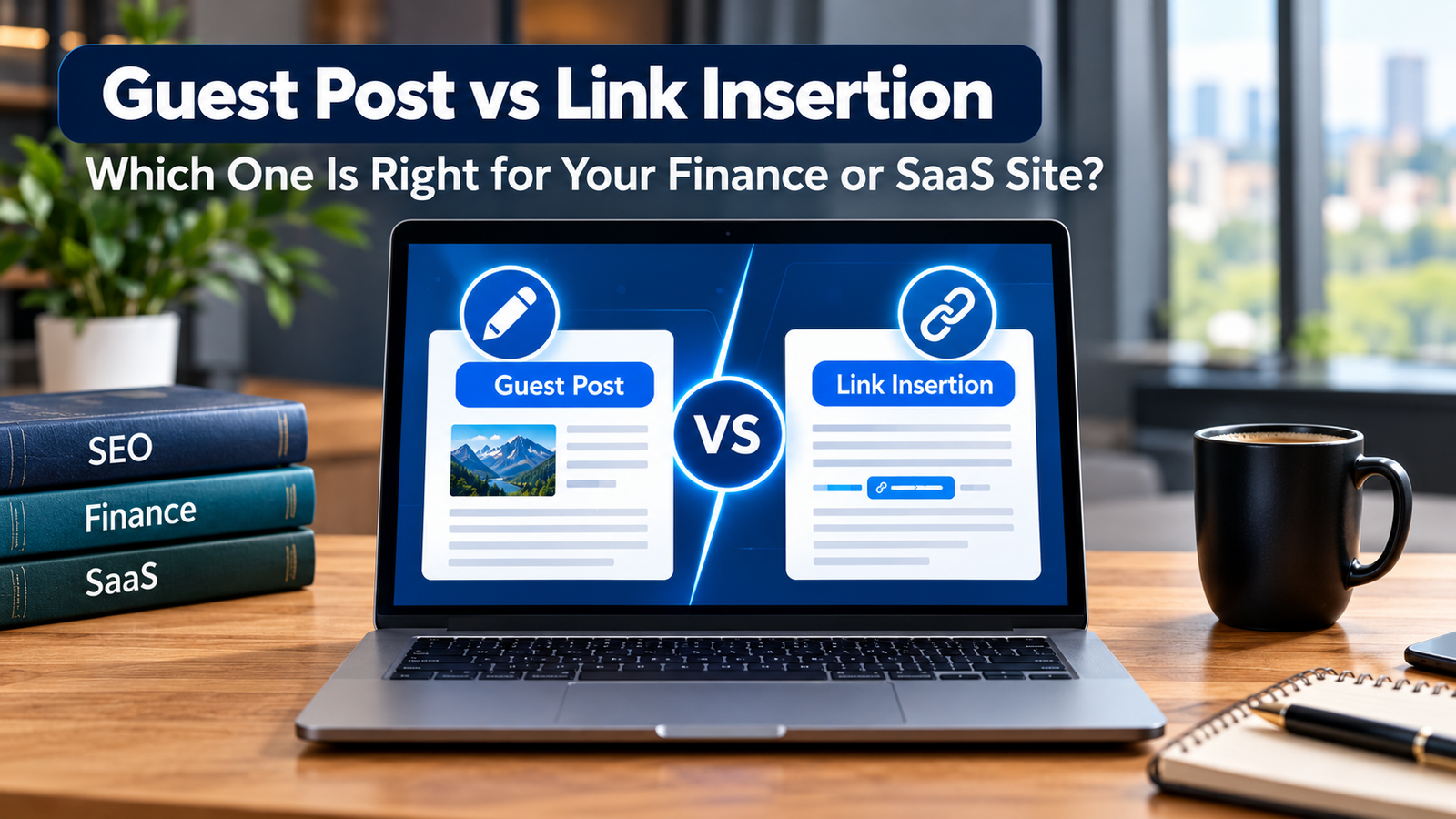
Ask any link builder for a quote and you’ll hear two terms again and again: guest post and link insertion. Both put your link on someone else’s website. Both can move the needle. But they work differently, they cost differently, and choosing the wrong one can burn a month of budget for very little return.
This guide breaks down how each option works, where it fits, and how to choose, especially if your site sits in finance or SaaS, where trust matters more than in most niches.
What Is a Guest Post?
A guest post is a brand-new article, written for another website and published there with a link back to yours. You pitch a topic, the site owner approves it, and the piece goes live, usually at 800 to 1,500 words.
The link normally sits inside the article body, in the author bio, or both. Because you control the topic and the angle, a guest post lets you show real expertise to a new audience. A fintech founder writing about cash flow for small businesses, for example, reaches readers who already care about that exact problem.

What Is a Link Insertion?
A link insertion, sometimes called a niche edit, adds your link to an article that is already published. The site owner updates a sentence or adds a short line so your page is mentioned where it genuinely helps the reader.
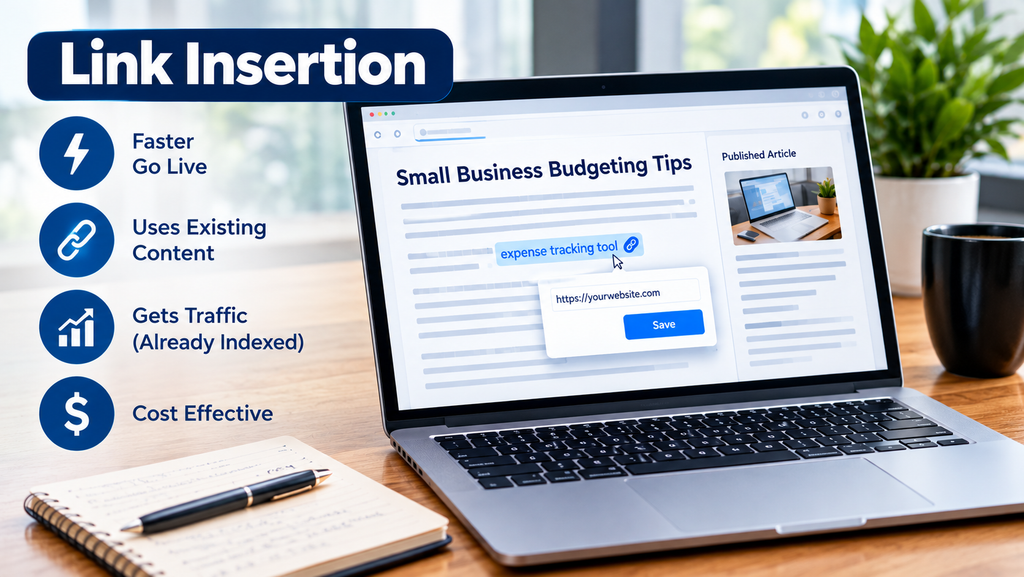
The big advantage is age. That article may already be indexed, ranking and getting visitors, so your link doesn’t have to wait for a new page to earn trust.
Guest Post vs Link Insertion: The Real Differences
Here is how they compare in practice:
- Speed: A link insertion can go live in days. A guest post needs a topic, a draft and an editor’s approval, so it usually takes longer.
- Control: With a guest post you decide the story and the context around your link. With an insertion, you fit into what already exists.
- Content value: A guest post gives you a full article that builds brand awareness. An insertion gives you a single mention.
- Existing authority: Older articles often carry traffic and links already. A new post starts from zero.
- Cost: Insertions are often cheaper because no writing is needed, though prices depend on the site.
When a Guest Post Makes More Sense
Choose a guest post when you want more than a link.
- You’re a newer brand and need visibility with a relevant audience.
- You have real expertise to share and want it attached to your name.
- You’re building a topic cluster and need supporting content on trusted sites.
- You want the link placed in a context that you wrote yourself.
A good guest post earns attention even if the link were removed tomorrow. That’s the test worth using.
When a Link Insertion Is the Better Pick
Go for an insertion when you need speed or want to support one specific page.
- Your pricing, comparison or landing page needs relevant links.
- An older article in your niche already gets steady traffic.
- Your budget is limited, but you still want relevant placements.
- You can’t wait for a full editorial process.
Say a SaaS company has a page about expense tracking. A mention inside an existing article about small business budgeting is far more useful than a random link from an unrelated blog.
Why Finance and SaaS Need Extra Care
Finance falls under what Google calls “Your Money or Your Life” topics. Advice here can affect people’s savings, taxes and big decisions, so Google expects stronger signs of trust. A link from a thin, off-topic site does little for you in this space, and sometimes it hurts.
SaaS has a different problem. Buyers research for weeks, compare tools and read a lot before they sign up. Links from sites those buyers actually read are worth much more than links from sites that only look good on a metrics tool.
In both niches, relevance beats raw numbers. A DA 40 site that your customers read is usually a better placement than a DA 70 site with no connection to your topic.

How to Check a Site Before You Buy a Placement
Don’t judge a site by DA or DR alone. Spend ten minutes on these checks:
- Traffic trend: Look for steady or growing organic traffic, not sudden drops.
- Relevance: Does the site cover finance, SaaS, business or tech? Do the articles read like they were written for people?
- Outbound links: If pages are packed with links to casino, loan spam or unrelated sites, move on.
- Indexing: Search
site:domain.comin Google. If few or no pages appear, that’s a red flag. - Content quality: Read two or three recent posts. If you wouldn’t trust the site yourself, your readers won’t either.
What Google Says About Paid and Manipulative Links
Google’s spam policies treat links made mainly to manipulate rankings as link spam, and they ask that paid or sponsored links carry the rel=”sponsored” attribute. Large-scale guest posting campaigns with keyword-stuffed anchor text are also called out as a problem.
What this means for you: keep anchor text natural (often your brand name or a plain description), keep the number of links reasonable, and never expect a placement to guarantee a ranking. No honest provider can promise that. Links are one signal among many.
Common Mistakes to Avoid
- Chasing DA only: A high score means little if the site has no real readers or no link to your topic.
- Using exact-match anchors every time: Mix brand names, plain phrases and page titles so the profile looks natural.
- Ignoring the article itself: If the content is weak, the link inherits that weakness.
- Buying in bulk before testing: Try one or two placements first and check indexing and referral traffic.
- Expecting overnight rankings: Links take time to be crawled and counted, so give each placement weeks, not days.
So, Which One Should You Choose?
There’s no single winner. Most healthy link profiles use both.
- Pick guest posts to build authority and brand recognition.
- Pick link insertions to support key pages quickly.
- Skip any option that puts your link on a site you wouldn’t read yourself.
If you’re unsure, start small: one guest post and one insertion on relevant sites. Look at referral traffic and indexing before you scale up.
Final Thoughts
Both methods work when the site is relevant and the link makes sense to the reader. Pick the one that matches your goal, check the site carefully, and keep things natural.
At Zee LinkHub, we offer guest posting, link insertion, link building and off-page SEO for finance and SaaS brands. If you’d like help choosing the right placements, get in touch for a quote.




Leave a Reply