
A link goes live on Monday. By Friday, the person who paid for it has checked their rankings six times and found nothing. By the following Monday they’re sure the link is broken, the site is junk, or the whole thing was a waste.
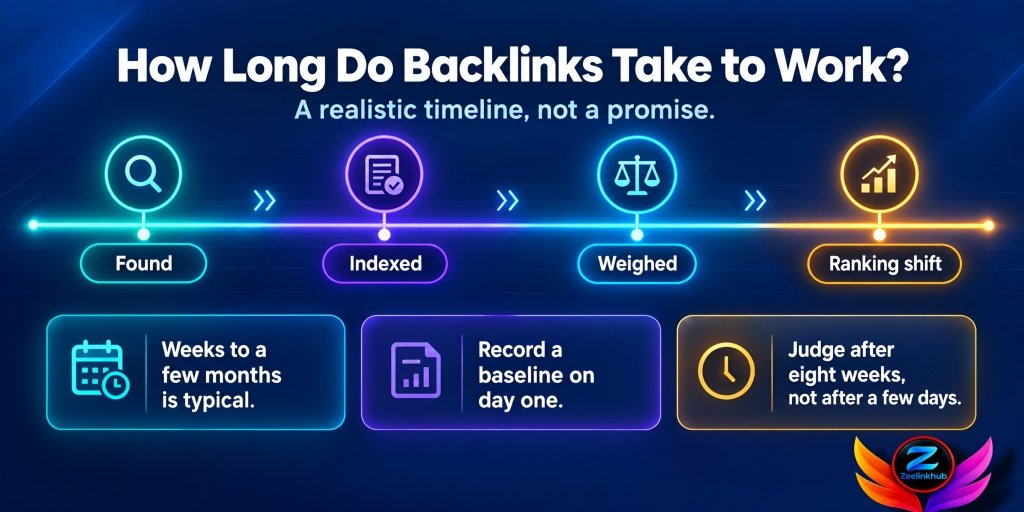
It’s one of the most common patterns in link building, and it usually comes from the same misunderstanding. A backlink isn’t a switch. It’s closer to a vote that has to be delivered, opened, counted and then weighed against everything else Google knows about your page.
So, how long do backlinks take to work? Here’s the honest version, including the parts nobody can promise.
How long do backlinks take to work, in plain numbers?
For most sites, you’re looking at a few weeks before you see any movement and often two to three months before the effect is clear. Some links show a small change within days. Others never seem to do anything measurable at all.
Google doesn’t publish a timeline, and anyone quoting you an exact number of days is guessing. What we have is observation: people tracking rankings before and after a link, over and over, across many sites. That gives us ranges, not rules.
If you want one sentence to remember, it’s this: how long do backlinks take to work? Longer than you’d like, and shorter than you fear. Give a new link at least six to eight weeks before judging it, and judge it against a baseline you recorded on the day it went live.
What happens between the link going live and a ranking change
It helps to know why “how long do backlinks take to work” has no single answer, because then the delay stops feeling like a problem.
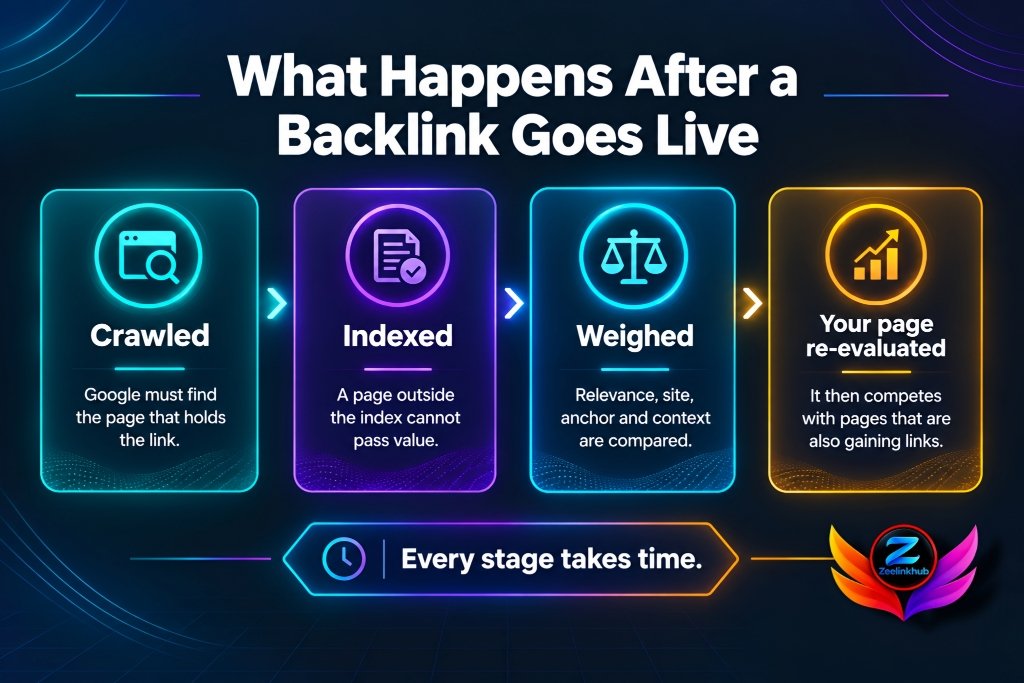
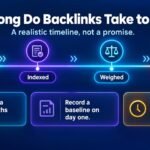
First, Google has to find the link. That means it must crawl the page that contains it. On a busy news site this can happen within hours. On a small blog that Google visits once a month, it can take weeks.
Next, the page has to be indexed. A link on a page that isn’t in Google’s index can’t pass anything useful along. This is the quiet reason many backlinks seem to do nothing. The link exists, but as far as Google is concerned, the page holding it doesn’t.
After that comes the weighing. Google looks at the linking page, the site around it, the topic, the anchor and the surrounding text, and compares all of that with what it already knows about your page. Your page is then re-evaluated, and that part isn’t instant either.
Finally, your page has to move against competitors who are also being evaluated, and who may be gaining links of their own. So the movement you see is a result of every one of those steps, not just the link itself.
What makes the wait shorter or longer
How long do backlinks take to work on your site specifically? The same link can take two weeks on one site and three months on another. A few things explain most of the difference.
The first is how quickly the linking page gets crawled. Pages on sites that publish often and get crawled often tend to be picked up faster. A link buried on an old, rarely visited page can sit unnoticed for a long time.
The second is the strength and relevance of the link. A link from a page that’s closely related to your topic, on a site with a real audience, tends to be weighed more heavily than a random mention. This is also why one good link can outperform five weak ones.
The third is how competitive the keyword is. If you’re targeting a phrase where the top results have hundreds of referring domains, a single link won’t visibly change much. If the competition is thin, the same link can move you quickly. Our article on how many backlinks you need to rank explains how to judge that gap.
The fourth is where your page already sits. A page ranking around positions 8 to 20 can respond fast, because a small boost may push it over the edge. A page that’s nowhere in the results usually needs more than a link, such as better content or a closer match to what people are actually searching for.
The fifth is the age and history of your site. A brand new domain tends to take longer, because it has little track record for Google to lean on.
Do backlinks work immediately?
Mostly, no. Occasionally you’ll see a jump within a few days, and it’s tempting to credit the link. But early movement is often noise. Rankings shift for dozens of reasons every week, including updates, competitor changes and testing on Google’s side.
I’d treat anything in the first week as a signal to keep watching, not a conclusion. If your page jumps three positions on day four and falls back on day nine, that doesn’t tell you much about the link in either direction.
The reverse is also true. A link that seems to do nothing in week one may start to matter in week six. That’s why a question like “how long do backlinks take to work” is better answered with a window than with a single day. Backlinks ranking time is rarely a straight line.
How to tell whether a backlink is actually working
Before you can answer “how long do backlinks take to work” for a specific link, you need a starting point. Before a new link goes live, or on the same day it does, write down a few things: the current position of your target page for its main keyword, its impressions and clicks in Search Console, and how many referring domains it has.
Then check the basics. Is the linking page indexed? Search the exact URL in Google and see if it appears. Does the link show up in your backlink tool? Is it followed or not, and is the anchor what you expected?
After that, track weekly, not daily. Look at average position, impressions, and whether the page started appearing for new related queries. Small increases in impressions often show up before clicks and rankings change.
Keep changes to a minimum while you wait. If you rewrite the page, add five other links and change the title in the same fortnight, you won’t know what caused what. A regular backlink audit can help you keep this under control by showing which links are new and which pages they point to.
Why a backlink might do nothing
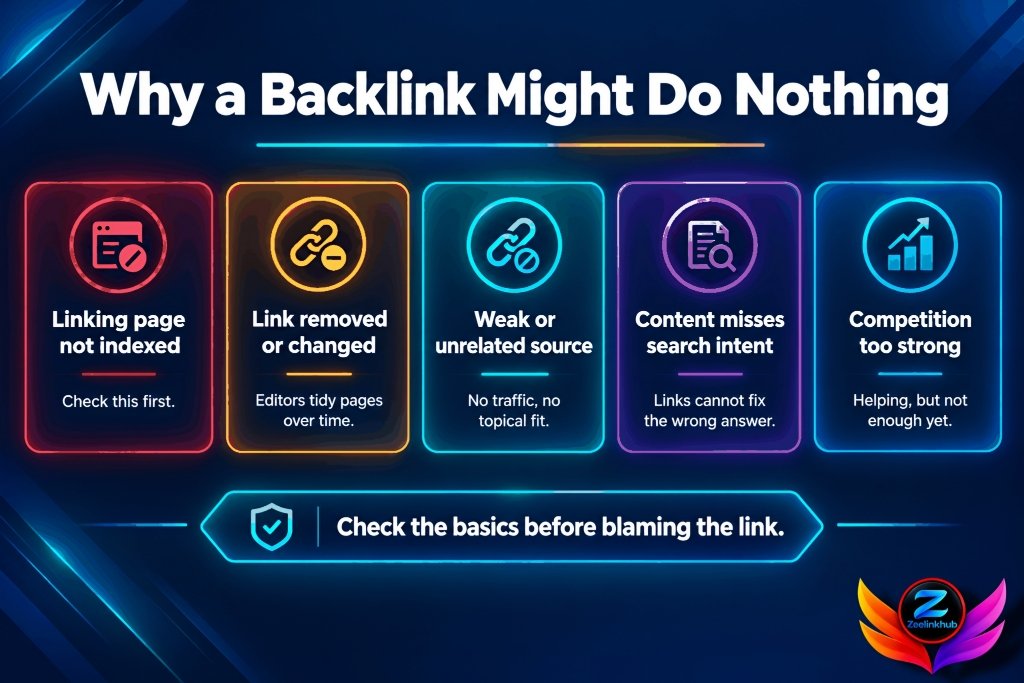
Sometimes the wait isn’t the problem. Here are the usual reasons a link doesn’t seem to work.
The page holding it isn’t indexed, or was indexed and then dropped. Check this first, because it’s the most common cause and the easiest to find.
The link was removed or changed. Editors tidy articles, sites get redesigned, and links disappear. If you suspect this, link reclamation covers how to find and recover lost links.
The link comes from a weak or unrelated page. Not every link carries meaningful weight, and a link from a site with no real traffic or topical fit may simply be ignored. If you’re not sure whether a link is a problem or just unhelpful, our guide to toxic backlinks shows how to tell the difference.
Your page doesn’t match what people want. Links can help a page rank, but they can’t fix content that answers the wrong question. If the top results are all guides and yours is a sales page, no amount of links will close that gap.
Or the competition is simply too strong. In that case the link may be helping, just not enough to show up yet.
How to help a new backlink along
You can’t force Google to move faster, but you can remove obstacles.
Make sure the page it points to is worth ranking. Check that the content matches the search intent, that the page loads well and that it’s linked to from other pages on your site. Internal links are one of the simplest ways to pass value to the pages you care about.
Don’t rely on one link. Several links arriving over weeks look more natural than one big batch, and our piece on link velocity explains how to pace them.
Keep your anchor text varied. A mix of brand names, plain URLs and natural phrases tends to look more believable than the same commercial phrase repeated every time. The guide on anchor text distribution covers this in detail.
And keep earning other links. A page that gains links steadily over months usually fares better than one that gets a single burst and then goes quiet.
What to expect in finance and SaaS
In these niches, the answer to “how long do backlinks take to work” is often longer than elsewhere. Both are slower than most. Finance content is judged more carefully, because it affects people’s money, so Google appears to look harder at trust signals. A new link to a loan or investing page may need more support, such as strong content and a clear author, before it shifts anything.
SaaS pages face a different issue. Comparison and “best tools” keywords are crowded with big brands, so a single link rarely changes much. In both cases, set your expectations to months, not weeks, and judge progress by impressions and the range of queries a page appears for, not only by one keyword’s position.
When to wait and when to look again
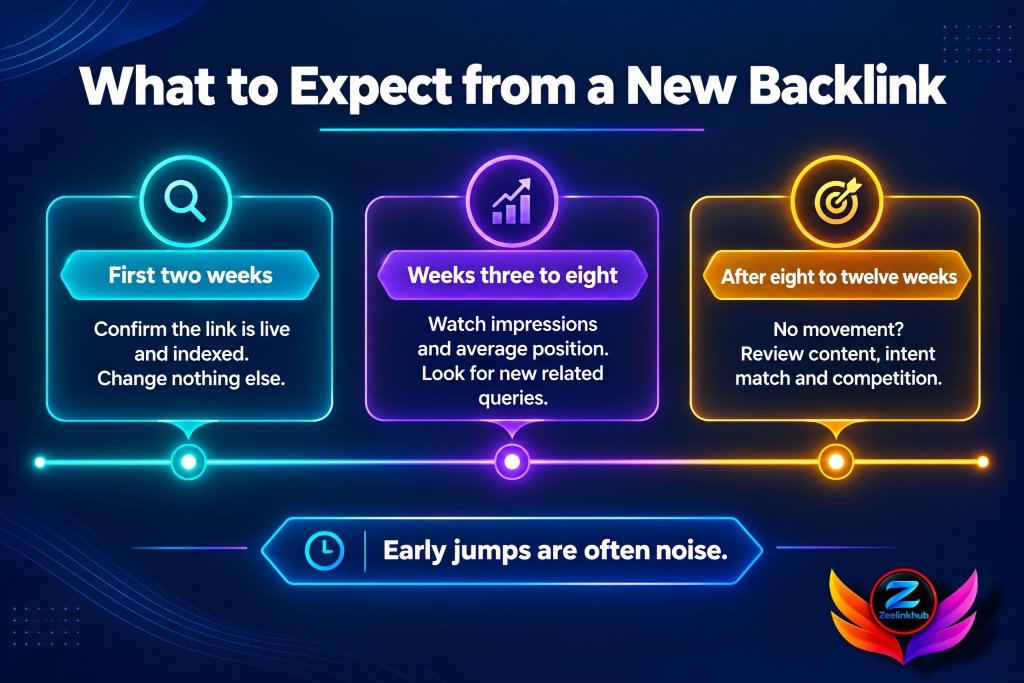
Here’s a simple rule I’d follow when the answer to “how long do backlinks take to work” starts to feel like forever. In the first two weeks, just check that the link is live and indexed, and don’t touch anything. Between weeks three and eight, watch the trend in impressions and average position. After eight to twelve weeks, if the linking page is indexed, the link is still there and you’ve seen no movement at all, it’s time to look at the other side: the content, the intent match and the competition.
That timing isn’t a guarantee. It’s a sensible window to avoid both panic and complacency.
Mistakes that waste time and money
Judging a link after a few days. Checking the wrong page, or only one keyword. Changing several things at once, so you can’t tell what worked. Buying more links before you’ve measured the last ones. Ignoring whether the page is even indexed. And expecting one link to do the job of ten.
Another quiet mistake is giving up too early on a good link because it didn’t act quickly. Links often keep working long after the first few weeks, and the effect can build as more signals pile up around the same page.
Final thoughts
There’s no clean answer to “how long do backlinks take to work”, but there is a sensible way to think about it. Expect weeks, plan for months, record where you started, and check the basics before you blame the link.
If you’re wondering how links fit into the bigger picture, including AI-driven results, do backlinks matter for AI search is a good next read.


Leave a Reply