
Ask five SEOs for the perfect anchor text mix and you’ll get five different answers. One says half your links should use your brand name. Another says seventy percent. A third says it doesn’t matter anymore.
Here’s the honest truth: nobody outside Google knows the exact numbers. But that doesn’t mean you’re guessing. The data gives us a fairly clear picture of what a natural profile looks like and what looks forced. This guide walks through that picture and shows you how to use it when you build or buy links.
The Five Anchor Types
Quick refresher, because the rest of this article depends on it:
- Branded: your name, like “Zee LinkHub.”
- Naked URL: the plain address, like “zeelinkhub.com.”
- Generic: words like “click here” or “this site.”
- Partial match: a phrase that includes your topic, like “a guide to link building.”
- Exact match: the exact keyword you want to rank for, like “buy backlinks.”
Exact match is the strongest hint about what a page is about. It’s also the easiest to abuse, which is why it gets so much attention.

What Google Actually Says
Google doesn’t publish a recommended ratio. What it does publish is a spam policy, and that policy points at the real problem. It lists links with optimized anchor text in articles and guest posts as a sign of link spam when they are built to manipulate rankings.
So the rule isn’t “never use keywords in anchors.” The rule is “don’t make it obvious that you engineered them.” A profile where most links use the exact same money phrase looks engineered, because real people don’t link that way. Real people link with your brand name, your page title, or whatever fits their sentence.
What the Data Shows
The best-known study here comes from Ahrefs, which looked at 384,614 web pages. It found that the share of exact-match anchors lined up with higher rankings. In other words, the signal is real, and that is exactly why people push it too far.
A more recent analysis from SEOJuice compared pages ranking in the top three with pages ranking on page two to five. The top group had more branded anchors, roughly 38 to 45 percent versus 22 to 28 percent. It also had far less exact match, about 3 to 8 percent versus 14 to 25 percent.
Notice what that suggests. The winners weren’t hiding keywords. They just had a lot of ordinary links around them.
Why You’ll See Different Numbers Everywhere
Search for “ideal anchor text ratio” and you’ll find one guide saying one to five percent exact match and another saying five to fifteen. Nobody is necessarily lying. The numbers depend on a few things:
- Your industry. Finance and SaaS are competitive, so people push harder.
- Your age and size. A new brand has fewer mentions, so its branded share starts lower.
- How you measure. Counting links is different from counting referring domains.
- Who ran the study. Most are small samples run by SEO vendors.
The author of the SEOJuice data says it well: treat the numbers as direction, not hard rules. In that view, a high branded share is a sign of a healthy profile, not a lever you can pull to create one.
A Simple Target You Can Actually Use
Here’s the rule of thumb we use. It’s our own judgment based on the patterns above, not an official number:
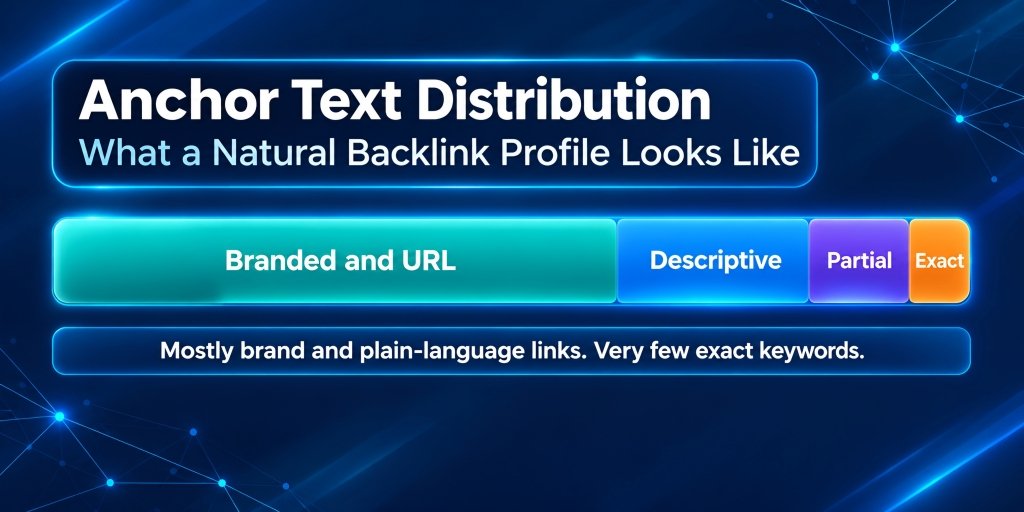
- Branded and naked URL: about half of your links, or more
- Generic and partial match: roughly a third
- Exact match: a small slice, from low single digits up to about ten percent at the very most
If you’re just starting out, lean even more toward brand and URL. And if one non-brand phrase keeps showing up again and again, that’s the first thing to fix.

What Natural Looks Like in Finance and SaaS
Finance. Natural anchors are brand names, calculator names, article titles and phrases like “this guide to index funds.” The Repeating a money phrase like “best credit card for travel” dozens of times is a flag, because real writers rarely link that way.
SaaS. Natural anchors are the product name, a feature name, or a plain description like “the invoicing tool.”
A pile of “best CRM software” anchors is what a bought profile tends to look like.
How to Audit Your Own Profile
You don’t need fancy software. Ahrefs and Semrush both have an anchor text report. Here’s a quick way to use it:
- Export your anchors and sort each one into the five types.
- Look at your top ten anchors. If a non-brand phrase beats your brand name, take a closer look.
- Check your newest links from the last 90 days, not just the full history. New links show what you’re doing now.
- Break it down by page. Your money pages usually have the worst mix.
- Repeat every quarter.
How to Order Links With Natural Anchors
If you buy guest posts or link insertions, anchor text is one of the few things you control. Our advice:
- Plan the mix for the whole batch, not for each link. For ten placements, something like five brand or URL, three descriptive, one or two partial, and zero or one exact match.
- Let the sentence decide. The anchor should read like something a writer would naturally say.
- Don’t reuse an anchor. If you used a phrase last month, pick a different one.
- Spread links across pages, not only your money page. Blog posts, guides and tools deserve links too.
- Keep paid placements modest. Google’s policy names optimized anchors in guest posts, so they get extra attention. We covered the wider risk in our article on whether Google penalizes paid backlinks.

If Your Profile Is Already Over-Optimized
Don’t panic, and don’t rush to delete things.
- Add balance. Earn new links with brand and URL anchors until the mix evens out.
- Ask politely. If a site owner can easily change an anchor to your brand name, ask.
- Use disavow carefully. Google describes it for large numbers of spammy or artificial links that caused, or are likely to cause, a manual action. It isn’t for routine cleanup.
- Be patient. Profiles shift slowly, so measure progress in months, not days.
Final Thoughts
There’s no magic ratio. There’s a pattern: mostly brand and plain-language links, some descriptive phrases, and very few exact keywords. If your profile looks like the one real people would build, you’re on the right track.
At Zee LinkHub, we place dofollow links only, and we plan anchors for the whole batch before anything goes live. See our guest posting and link placement services or request a quote. And if you’re still choosing a format, our comparison of guest posts vs link insertions is a good place to start.



Leave a Reply