
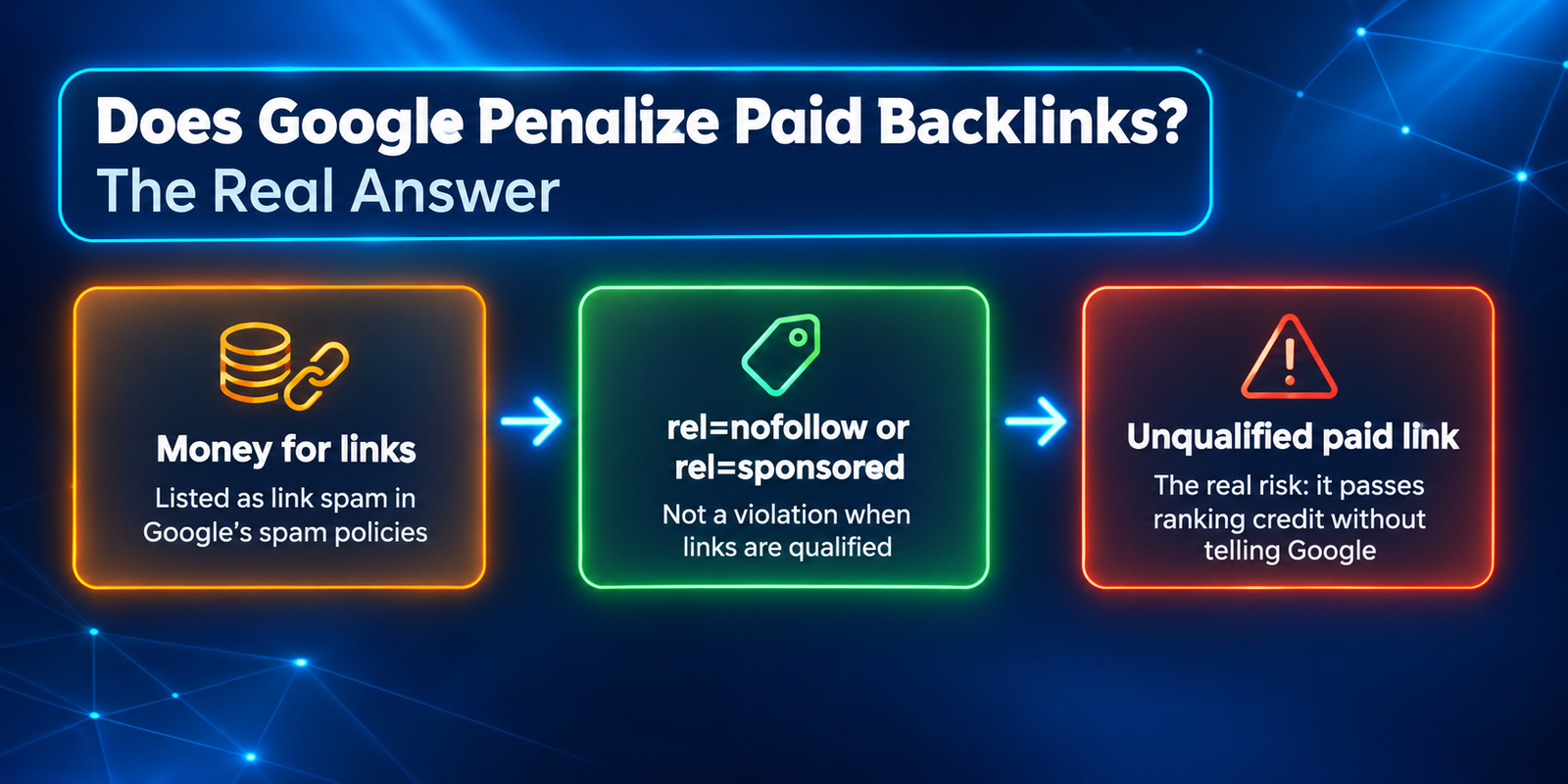
Google says that exchanging money for links violates its spam policies. Meanwhile, an entire industry sells guest posts and link placements every day, and plenty of sites rank with paid links somewhere in their profile. Both things are true at once, and that gap is where most buyers get hurt.
This article skips the myths on both sides. You’ll see what the policy actually says, how paid links get caught, why a penalty is only one of the possible outcomes, and how to reduce your exposure if you decide to buy links anyway.
What Google’s Policy Actually Says
Google’s spam policies define link spam as links created mainly to manipulate rankings. The list of examples includes exchanging money for links, or for posts that contain links. Excessive link exchanges and partner pages built only for cross-linking sit on the same list.
Here is the detail most people miss. The policy also says it isn’t a violation to have such links as long as they are qualified with a rel=”nofollow” or rel=”sponsored” attribute. So payment by itself isn’t the problem. The problem is a paid link that passes ranking credit without telling Google.
That has an uncomfortable implication for anyone buying standard dofollow placements: by Google’s own wording, you are in the risk zone. It doesn’t mean you will be penalized. It means you’re taking a risk, and you should know that before you spend the money.
How Paid Links Get Caught
Google says it detects violations through automated systems and, when needed, human review that can lead to a manual action. In practice, two mechanisms matter.
Automated detection. SpamBrain is Google’s machine-learning system for spam. Since the December 2022 link spam update, it has reportedly evaluated both the sites that buy links and the sites that sell them, and it can cancel the ranking value a manipulative link was passing.
Manual review. If a human reviewer finds a pattern of unnatural links, you’ll see a manual action in Search Console. This is the only version that arrives with a notice and a way to request reconsideration.
Footprints give sites away. A section that exists only to host third-party articles, or dozens of unrelated brands linking out from the same domain, are exactly the kind of patterns a system can learn.

Penalty vs Devaluation
Most buyers think the risk is a penalty. The more common outcome is quieter: the link just stops counting.
When an automated system neutralizes a link, nothing is reported in Search Console, and there is nothing to appeal. You simply paid for a link that does nothing. A manual action is the louder and rarer outcome, and it usually follows a clear pattern, not a single link.
Think about the risk in three levels:
- Wasted spend: links quietly ignored. This is the most likely result.
- Partial loss: part of your link profile gets discounted, sometimes alongside ranking drops.
- Manual action: a visible penalty after a pattern of manipulation. Least likely, and the most painful.
This changes how you should judge price. A cheap link that can be neutralized isn’t a bargain at any amount.

What Raises Your Exposure
Google doesn’t publish a checklist, so treat these as patterns that tend to make a link profile look manufactured:
- Placements on sites that sell links to anyone with a budget
- Links on pages with no connection to your topic
- The same exact-match anchor repeated again and again
- A sudden spike of links from similar-looking sites
- Posts that read like filler, with no real readers behind them
- Sitewide or footer placements on unrelated domains
None of these proves a violation on its own. Several together are what make a profile stand out.
How to Buy Links With Lower Risk
1. Choose the format on purpose. A link placed inside an existing, relevant article often looks more natural than a brand-new post written just to carry a link, but each format has its own trade-offs. Our breakdown of guest posts vs link insertions explains which one fits which goal.
2. Buy relevance, not scores. A site your customers actually read is safer and more useful than a high-metric site with no audience. Check traffic trends, indexing and the quality of recent posts before you pay.
3. Keep anchors natural. Use your brand name, your page title or a plain description most of the time. Save keyword-style anchors for rare cases.
4. Know the link type you’re buying. Standard dofollow placements pass ranking credit, which puts them in the risk zone under Google’s wording. That’s a real trade-off, not a technicality. If you buy them, buy fewer and buy better, and treat them as one part of a wider mix. If avoiding policy exposure matters more to you than ranking value, a sponsored or nofollow link still brings referral traffic and a brand mention, and mentions have value of their own, as we covered in do backlinks still matter for AI search.
5. Don’t build everything on paid links. Mix in links you earn: original data, tools, useful guides and real outreach. A profile that is only paid placements is easier to spot than a mixed one.
6. Pace the buying. Add links gradually and from different kinds of sites. A burst of identical placements looks very different from steady growth.
7. Monitor after you buy. Check the Manual Actions report in Search Console, watch your traffic after each batch, and confirm every page is indexed.

If You Think You’ve Been Hit
Start with the facts, not the panic:
- Check Manual Actions in Search Console. If there is one, follow the instructions it gives and submit a reconsideration request once the problem is fixed.
- No notice, but traffic fell? It may be an algorithm update or neutralized links, and there is nothing to appeal. Review your content, check indexing, and keep earning links that are hard to dismiss.
- Use disavow carefully. Google describes it for cases with a large number of spammy or artificial links that caused, or are likely to cause, a manual action. It isn’t a routine clean-up tool.
Final Thoughts
Paid dofollow links aren’t a guaranteed penalty, and they aren’t risk-free either. Google’s policy puts unqualified paid links in the risk zone, detection keeps improving, and the most common cost is wasted money, not a dramatic penalty.
At Zee LinkHub, we place dofollow links only, and we tell you that upfront. We choose sites by relevance and real traffic, keep anchors natural, and recommend that you pace your orders. If that fits your risk level, see our guest posting and link placement services or request a quote.


Leave a Reply