
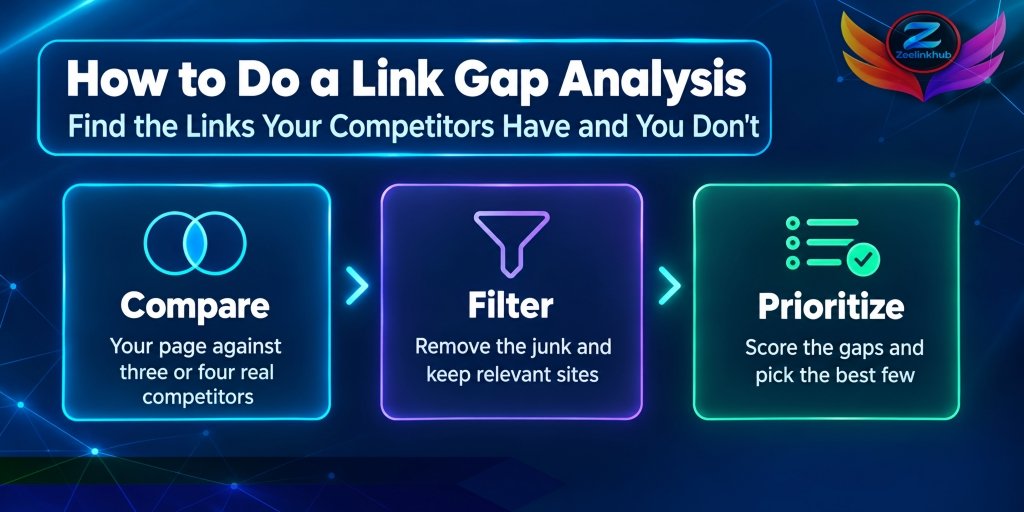
Knowing how to do a link gap analysis is one of those skills that sounds technical until you try it. The idea is simple. You find the sites that link to your competitors but not to you, then work out which of those links you could realistically earn. Done well, it turns a vague plan like “we need more links” into a list of real names.
Done badly, it’s a spreadsheet of eight hundred domains that nobody ever emails. That’s where a lot of teams end up. This guide walks through seven steps, what to filter out, and how to decide which gaps are worth your time.
How to do a link gap analysis: what you’re actually looking for
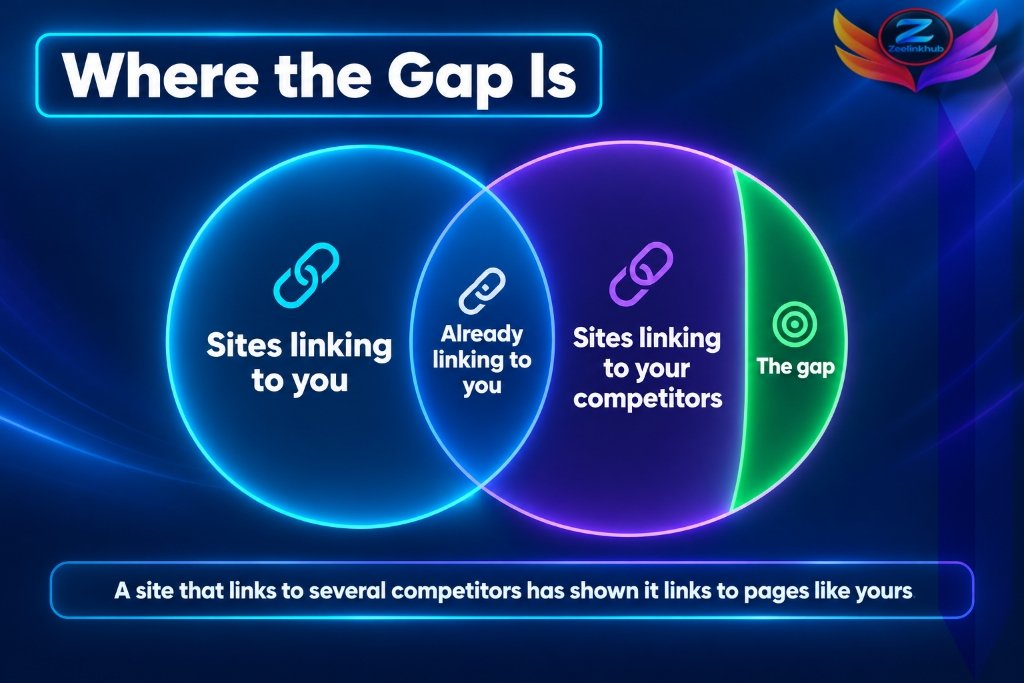
A link gap analysis compares your backlink profile with the profiles of the pages you compete with. The result is a list of referring domains that link to them but not to you.
That list tells you two things. It shows where your niche is willing to link, and it shows which kinds of pages earn those links. If five competitors have a link from the same industry blog, that blog has already shown it links to sites like yours. You aren’t guessing anymore.
What it doesn’t tell you is which of those links are worth having, or how they were earned. That part is on you, and it’s most of the work.
Step one: Pick one page and one keyword
Don’t run the analysis on your whole site first. It produces too much data and hides the useful stuff. Pick one page you want to rank and the keyword you want it to rank for. If you’re not sure how many links that page needs, work that out first. We covered the method in how many backlinks you need to rank.
Page-level gaps are usually more useful than domain-level ones. The sites that link to a single comparison page behave very differently from the sites that link to a homepage.
Step two: Choose competitors that make sense
Use the pages that actually show up in the top results for your keyword. Three or four is plenty. Most tools compare about that many comfortably, and more competitors just means more noise.
Avoid the giants. A site with years of coverage and a PR team has links you can’t get, and those links will bury the ones you can. A smaller competitor that ranks above you is usually more useful than a famous one that doesn’t need your help.
Step three: Run the link gap analysis report
In Ahrefs, the feature is called Link Intersect. In Semrush, it’s Backlink Gap. Both work the same way. Enter your domain or page, add your competitors, and ask for the domains that link to them but not to you.
Start with the intersect count, which is how many of your competitors each domain links to. A site that links to three of your four competitors has shown, again and again, that it links to pages like yours. A site that links to just one might be a one-off. Sort by that column before anything else.
Export the list. Don’t email anyone yet.
Step four: Clean the list
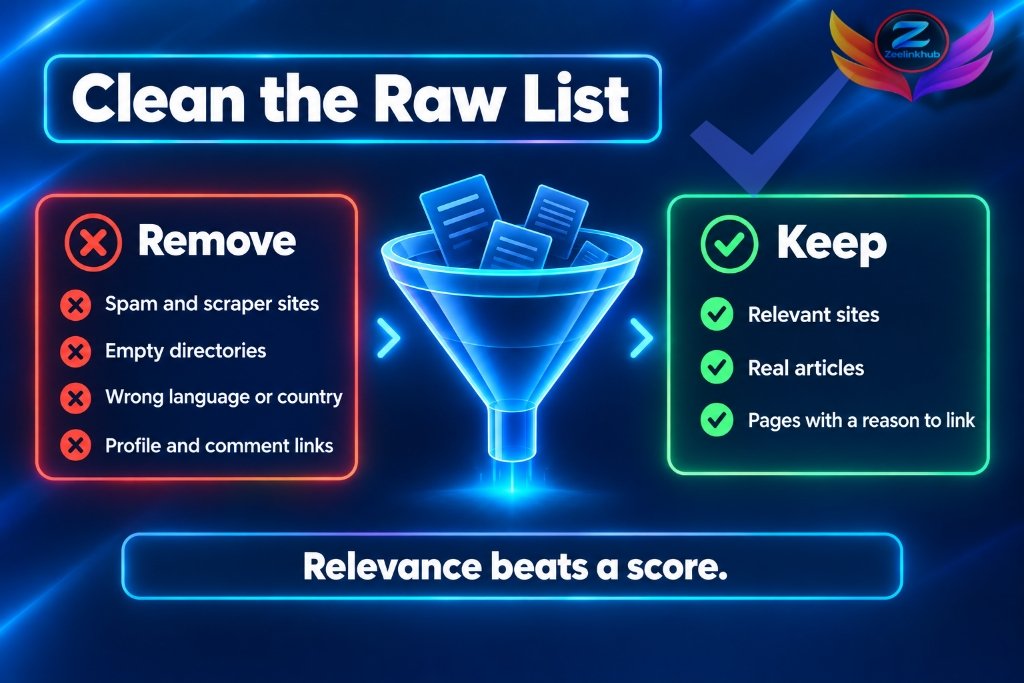
Every raw report contains junk. Remove obvious spam, scraper pages, directories with no real content, and anything in a language or country you don’t serve. Delete forum profile links and blog comment links unless they sit inside a real discussion.
Be careful with DR and DA filters. A common rule is to throw away anything under DR 30, but that cuts some of the best opportunities, like small niche blogs your customers actually read. Relevance beats a score. Filter by topic first and use the metric only to break ties.
Then open a few of the pages that carry the link and ask one question: what earned this link? If the answer is a useful guide or a good tool, you’ve learned something. If the answer is that someone paid, that’s a signal too, and you should think about whether you want to copy it.
Step five: Sort the gaps by link type
Group what’s left. Most gaps fall into a handful of buckets:
- Resource pages and roundups
- Editorial mentions inside articles
- Guest posts and contributor columns
- Reviews and directories that matter in your niche
- Partnerships and integrations
Some of these you can earn with outreach. Some need a product or a relationship. A link from a partner’s homepage or an investor page will almost never be available to you, so cross those off. Sorting this way stops you from sending one generic pitch to everyone.
Step six: Score what’s left
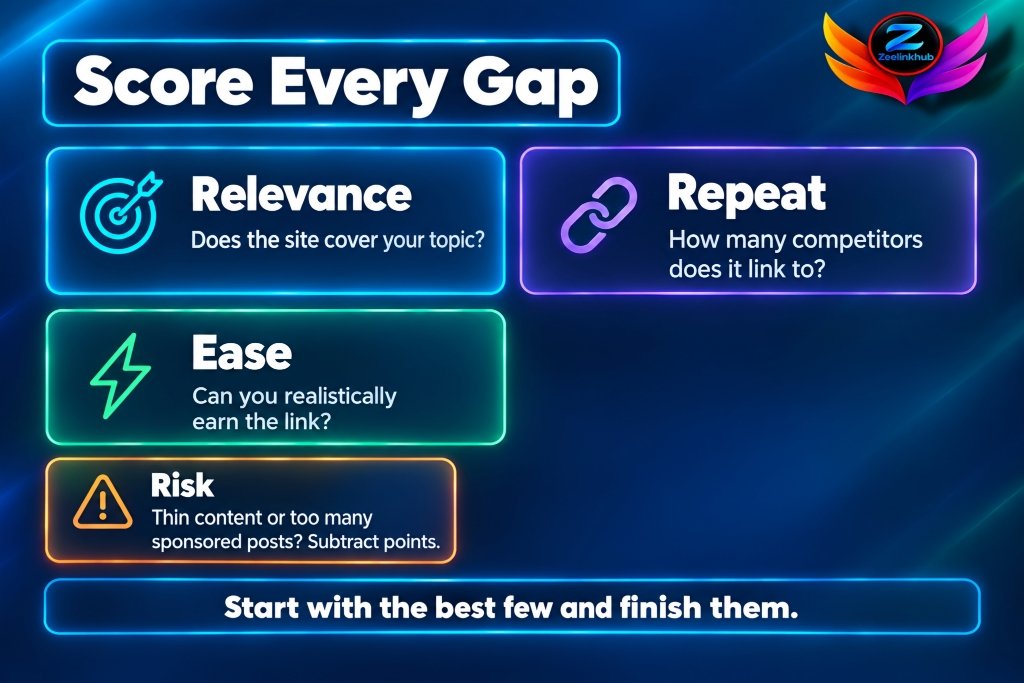
A simple scoring system saves a lot of arguing. Give each domain points on four things.
Relevance: does the site cover your topic? Zero to three points. Repeat: how many competitors does it link to? Zero to three. Ease: could you realistically earn a link there with your resources? Zero to three. Risk: does anything about the site make you nervous, like thin content or too many sponsored posts? Subtract one or two.
Add it up and start at the top. If you only have time for five domains this month, pick the five best scores and see them through. One finished result gives you better data than fifty half-started pitches.
A quick example
Say you run a small finance site with a loan calculator, and you want to rank a page for “mortgage payment calculator.” You pick three competitors that rank near you, run the gap report, and get 412 domains that link to at least one of them but not to you. These numbers are made up, but the shape is realistic.
After cleaning out spam, thin directories and sites in the wrong language, 140 are left. You sort those by link type and find that 38 are resource pages and roundups, 22 are editorial mentions, and the rest are mostly directories and partnerships you can’t touch. You focus on the first two groups.
Scoring cuts it down again. Twelve domains score high on relevance, link to at least two competitors, and look realistic. You pick five and write down what each one would need: a better calculator page for one, a data point for another, a short expert comment for a third.
That’s the whole point. You started with 412 names and ended with five clear next steps.
Step seven: Act, then check back
For each target, decide what you’re going to offer. A gap that came from a guide needs a guide that’s better or different. A gap that came from a tool roundup needs a tool. Asking “please link to us” is the weakest pitch you can make.
Then put a date on your calendar. Competitors keep earning links, so the gap keeps changing. Rerunning the analysis every few months is plenty, and keeping notes on which approaches got replies makes each round shorter than the last. If paid placements are part of your plan, keep anchors natural, which we explained in anchor text distribution, and understand the risk in does Google penalize paid backlinks.
What to expect after you start
Be realistic. Most pitches won’t get a reply, and that’s normal. A good round of a link gap analysis often produces just a handful of links, and that can be enough to move a page when those links come from sites that really match your topic.
Replies usually show up within a couple of weeks. Links that go live can take a month or two, since editors have their own schedules. Give each target a fair follow-up, one polite nudge after about a week, and then move on.
Finance and SaaS notes
In finance, expect fewer open doors. Many gap domains will be big publishers and trusted sources, and trust matters more here, so quality filtering matters even more. Look closely at who is linking and whether the content around the link is accurate.
In SaaS, the gaps often come from integration partners, review sites and “best tools” roundups. Those make good targets because the link has a clear reason to exist.
Mistakes that waste the most time
The usual ones are chasing every gap, filtering by DR alone, emailing the whole export, and copying links you couldn’t earn the same way. Another is skipping the page-level view and running the report at the domain level only. And a lot of people run it once and never again.
Final thoughts
A link gap analysis won’t earn links for you. What it does is replace guesses with names, and it shows you which kind of page your niche links to. Start small: one page, three competitors, five targets. Do those well, check what worked, then run the next round.





Leave a Reply