
Here’s a pattern I see all the time. Someone writes a decent article, spends an evening building a list of fifty blogs, sends fifty emails, and gets two replies. One says no. The other wants money.
Then they decide outreach doesn’t work. But outreach wasn’t really the problem. The page just gave nobody a reason to link to it. Linkable assets are the fix for that, or at least the best one I know. You build the thing people have to point to, and asking for the link gets a lot less awkward. Sometimes you don’t even have to ask.
I’ll go through what counts as a linkable asset, which types are worth the effort, and how to sanity-check an idea before you sink a month into it.
So what are linkable assets, exactly?
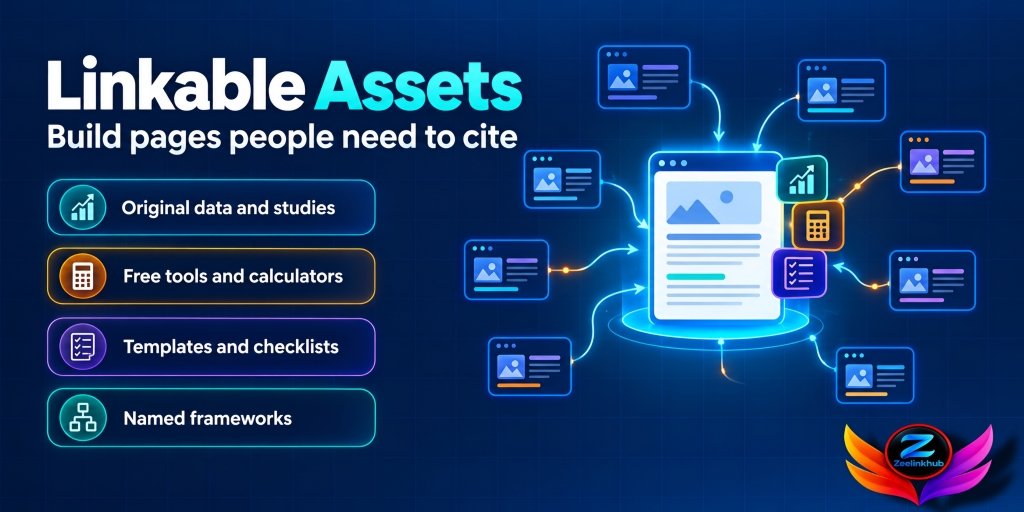
A linkable asset is a page you build mainly because it’s likely to earn links. It has something in it that other people want to reference: original numbers, a free tool, a clear definition, a template, a method with a name.
Notice what that leaves out. A good blog post isn’t automatically one. I’ve read plenty of well-written articles that never picked up a single link, and the reason is boring. They say what ten other pages already say, so nobody needs this one in particular.
Here’s a quick test that works surprisingly well. Picture a writer working on a piece about your topic. Can they make their point without mentioning you? If yes, you don’t have an asset yet. If they’d have to go and find your page, or leave a hole in their article, you probably do.
What makes one linkable
Go and look at pages that keep gaining links for years. Not the viral ones, the quiet ones. They tend to share a few traits, and none of them is “nice design.”
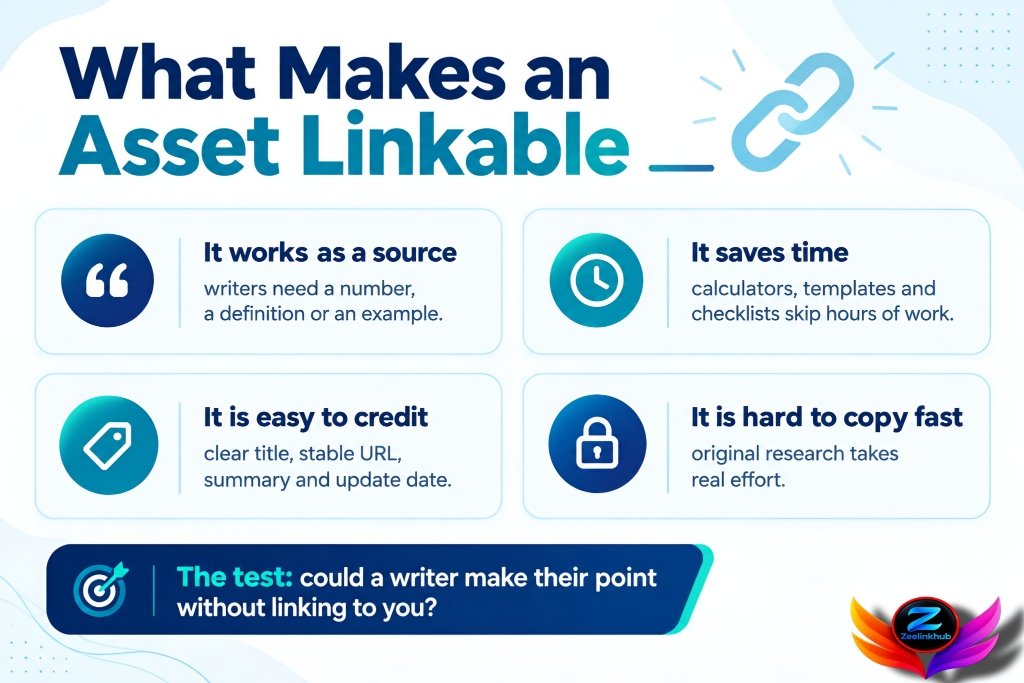
They give people something to cite. A figure, a definition, an example. A writer in the middle of a paragraph needs a source, and yours happens to be the clear one.
They save time. Think of a calculator that does in ten seconds what takes half an hour in a spreadsheet. People link to those because it helps their readers, and it makes the writer look useful.
They’re easy to credit. This sounds minor but it isn’t. A page with a clear title, a permanent URL, a short summary near the top and a visible “updated” date is simply easier to reference than a page where the key point is buried in paragraph nine.
And they can’t be reproduced in an afternoon. That’s what kills most “tips” posts. If it took you two hours, someone else can do it in two hours, and then there are five of them.
Types of linkable assets that earn links
I’ll go roughly from most reliable to least, though honestly it depends on your niche.
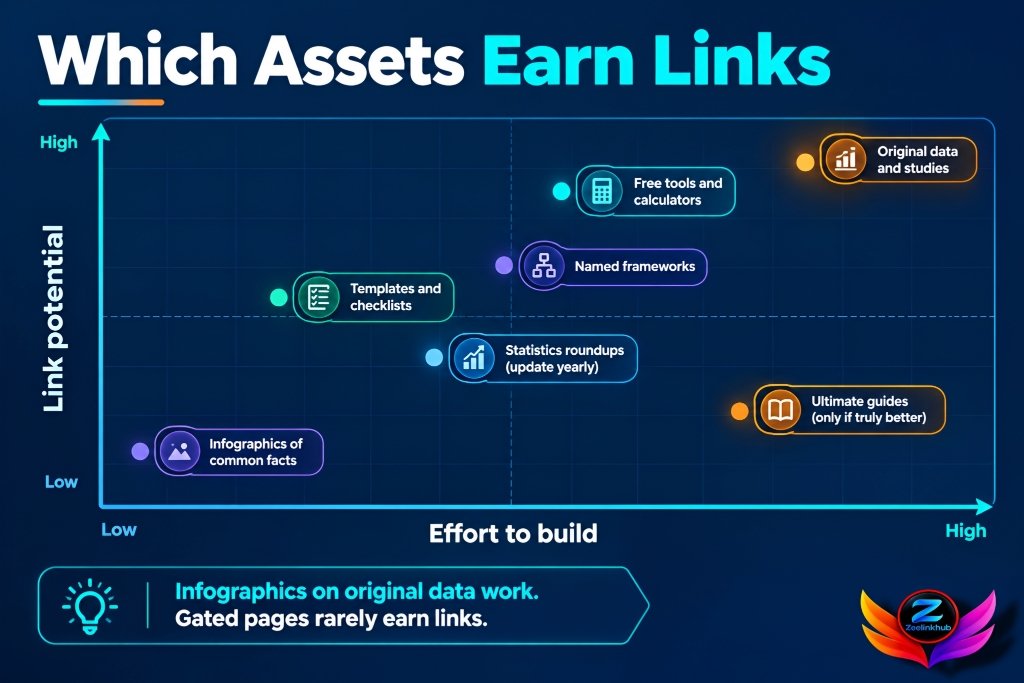
Original data comes first. If you have your own numbers, from a survey, from your product, or from a public dataset you analyzed in a way nobody had, writers can’t get that anywhere else, so they have to link to you. The catch is that it’s expensive. A sloppy survey (forty respondents and a headline that overreaches) tends to get ignored, or even picked apart. If the data is weak, it’s better not to publish it.
Free tools are next. A calculator or checker that solves one real problem gets linked from resource lists and forum threads, and it keeps getting found because people search for it. But tools need upkeep, and a tool that’s only a bit worse than the one everybody already uses won’t earn much.
Templates and checklists are the cheap version of that. A template readers can copy straight into their own work gets linked from how-to articles all the time. One thing I’d avoid is putting it behind an email form. Gated pages almost never earn links, because a writer can’t comfortably send readers somewhere that asks for their email first.
Named frameworks are underrated. If you take a method you actually use, give it a clear name and explain it properly, other people can cite it by that name. It takes real thinking rather than real budget, which is probably why so few people do it.
Statistics roundups can work, with a warning. Writers love ready-made numbers. But most roundups are copies of other roundups, with figures three years old and sources that no longer exist. If you build one, go back to the original source of every number and refresh the page every year. Otherwise, don’t bother.
Case studies and experiments sit somewhere in the middle. A real test with real results, including the ones that didn’t work, reads as honest and gets cited. Show your method, or it just reads like marketing.
“Ultimate guides” still work sometimes. But it’s the most overbuilt format on the web. A guide earns links only when it’s truly the best answer, not when it’s simply the longest.
Infographics I’d put last. A tidy graphic of facts everyone already knows earns close to nothing. One built on original data is a different story, because the data is the asset and the graphic is just a good way to carry it.
Which types suit finance and SaaS
Finance is unforgiving about accuracy. Calculators, rate trackers and analyses built from public data work well, but only when they’re right and clearly dated. One wrong number in a finance asset doesn’t just cost you links. It costs you trust.
SaaS companies usually have an advantage they never use. They sit on product data that would make a great benchmark study, and they never publish it. Templates for common workflows and small free utilities also tend to do well.
A quick example
Say you run a site about freelance invoicing. The obvious article is “How to write an invoice.” There are thousands of those. Nobody has a reason to link to yours.
Now ask what’s hiding behind the topic. People keep asking how much to charge, what happens when a client pays late, and which details an invoice must contain. A free template that covers the required fields. A late payment fee calculator. A small study of how long invoices stay unpaid in different industries. Any of those gives a writer something to point to.
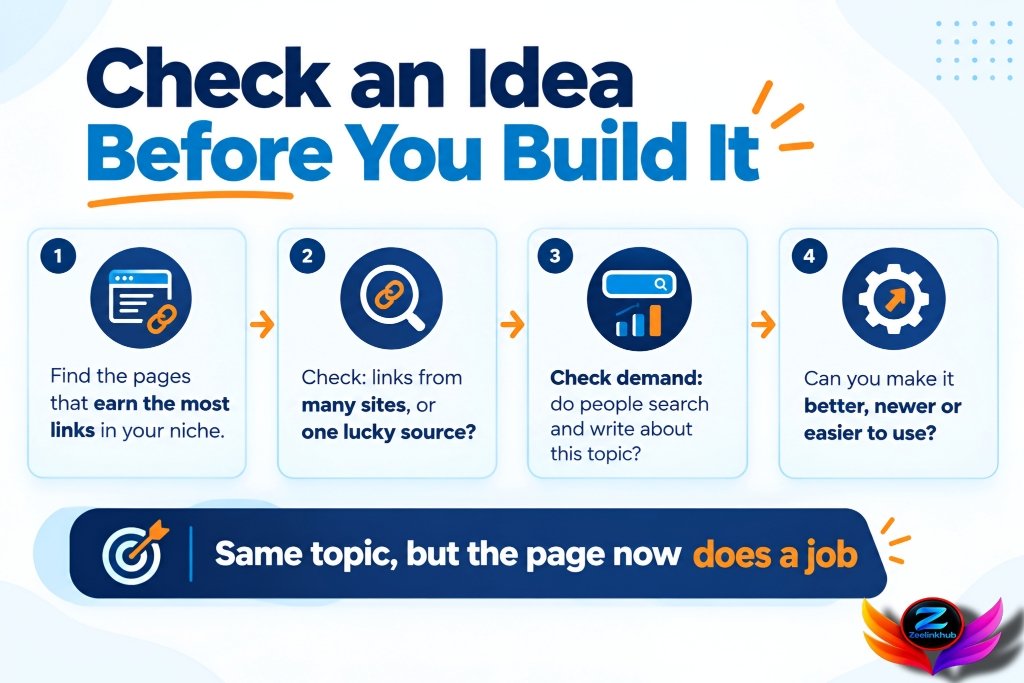
The topic didn’t change. What changed is that the page now does a job. Linkable assets link building really comes down to that shift, and it’s the question I’d ask every time you plan a page: not “what should I write?” but “what could I build that someone writing about this would need?”
Check the idea before you build it
An hour here can save you a month.
Start with what already works. In Ahrefs or Semrush, look at your competitors’ pages sorted by referring domains. There are two things to check. Did the page earn links from lots of different sites, or from one lucky mention? And what format is it?
It’s the same reasoning behind a link gap analysis. Find what’s already working in your niche, then decide how to do it better, or differently enough that it earns its own links.
Then check demand. Are people searching for this? Do writers keep covering the topic? An asset about something nobody writes about rarely gets cited, however good it is.
And be honest with yourself about whether you can beat what exists. If your plan is the same thing with a few extra paragraphs, skip it. Find a fresher dataset, a new angle or a more usable format.
Build it for the person who’ll cite it
You’re writing for two people: the reader, and the writer who might link to you. Most assets only think about the first.
Put the key number or definition near the top, in plain words. Writers skim, and if they can’t find the quotable bit in about ten seconds, they leave. A short summary box helps. Explain your method so the numbers look trustworthy. Add an update date. Use a clean URL and then never change it.
For tools and visuals, make sharing easy. If crediting you is the obvious thing to do, more people will do it.
Assets don’t promote themselves
Here’s where most people give up too early. They publish a brilliant asset, wait three weeks, see nothing and decide the whole idea is a myth.
Even great assets need a first push. Make a short list of people who’d actually care: writers who’ve linked to similar pages, newsletter authors in your niche, communities where the topic comes up. Send each of them a short message that’s specific to them, saying what it is and why their readers would find it useful. Not fifty copies of the same email.
And be patient. Links tend to arrive in waves, and a good asset can keep earning for months. If you’re wondering what normal looks like, our article on link velocity covers how links usually come in.
Keep your assets alive
Once an asset starts earning links, it’s probably one of your most valuable pages, so treat it like one.
Update it at least once a year, numbers especially. Keep the URL stable. If you ever merge or move the page, redirect it with care, because losing the links to an asset hurts more than losing them to a regular post. Our guide to link reclamation shows how to win links back when something breaks.
Check which assets are actually doing the work, too. A regular backlink audit shows which pages attract the most referring domains, which tells you what to build more of.
And one small habit: link from your asset to the pages you want to rank. Internal links are how that value moves where you need it.
Mistakes that sink linkable assets
Building something nobody needs. Copying an “ultimate guide” and adding a few paragraphs. Using numbers you can’t trace to a source. Gating the page behind a form. Skipping promotion. Never updating it. And judging success by page views when what you care about is referring domains.
Final thoughts
Linkable assets work because they flip the question. You stop asking strangers for a favor and start giving them something worth citing. Pick one type that suits your niche, check that it’s worked for someone else, make yours better, and then put it in front of the right people.
Once the links start arriving, how many backlinks do you need to rank is a good way to work out how many you’re aiming for.





Leave a Reply