
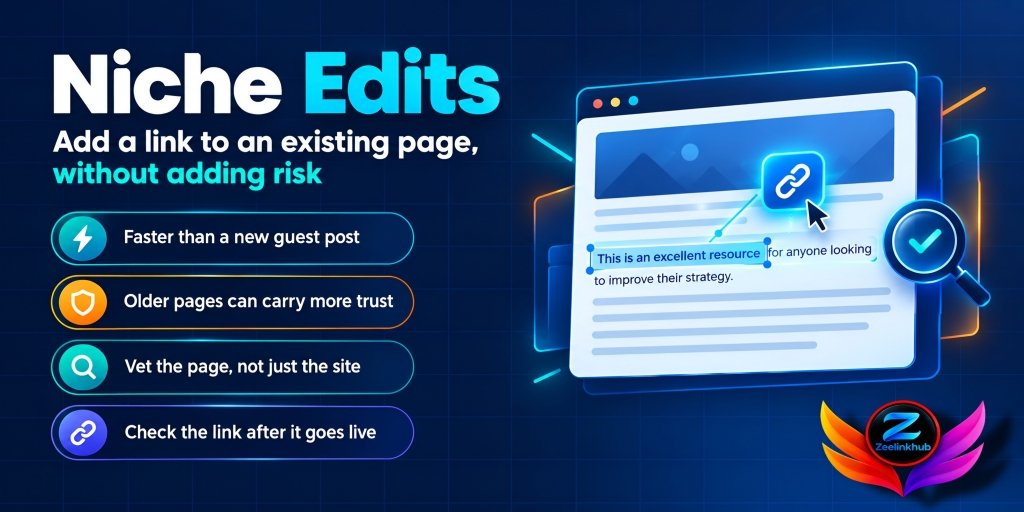
Niche edits are one of those link building tactics that everyone has an opinion on and few people explain properly. Some SEOs swear by them. Others call them a shortcut that eventually gets sites in trouble. Both camps have a point.
The idea is simple. Instead of publishing a brand new article and getting a link inside it, you get a link added to an article that’s already live. That page already has a publish date, maybe some traffic, maybe a few links of its own. Your link just joins it.
This guide looks at niche edits the way I’d look at them before spending a client’s budget. How they work, where they go wrong, and how to tell a good placement from one you’ll regret.
What niche edits actually are
A niche edit is a link placed inside existing content on another website. The editor either adds a sentence with your link, or changes an existing mention so it points to you. Some people call it a link insertion or a curated link. In practice the terms get used for the same thing.
The “niche” part matters. The link should sit on a page that’s actually about your topic, in a paragraph where it makes sense for the reader. A link to a loan calculator inside an article about mortgage refinancing is a niche edit. The same link dropped into a recipe blog is just a link.
If you want the full comparison with writing a fresh post, our breakdown of guest posts versus link insertions covers the trade-offs. This article is about what comes after you’ve decided niche edits are on the table.
Why people like them
Speed is the first reason. A new guest post needs a pitch, a draft, edits and a publishing slot. A niche edit can go live in days, because the page already exists.
Age is the second. A page that has been indexed for years, collected links and earned some trust can pass more value than a freshly published one. Google already knows the URL and has crawled it many times.
Cost is the third. For the same site, a link insertion usually costs less than a full article, because nobody has to write anything new.
Those are real advantages. They’re also exactly why niche edits get abused.
Where they go wrong
Here’s the uncomfortable part. Google’s spam policies treat links that are bought or exchanged mainly to pass ranking signals as link spam. That includes a link added to an old article in return for money. Anyone who tells you niche edits are “completely safe” is either guessing or selling something.
What actually decides the risk isn’t the label. It’s how the link looks and where it sits.
The most common failure is a page that was never meant to carry a link. Imagine an old article, three years untouched, with a sudden new sentence about a payment processor in the middle of a paragraph about gardening. A human sees that in two seconds. So does an algorithm.
The second failure is a site that sells links to everyone. If a domain has a “write for us” page, a price list, and outbound links to casino, loan and pharma sites in the same article, your link is sharing a room with trouble.
The third is fragility. An edited link can disappear the next time the editor refreshes the post, redesigns the site or cleans up outbound links. Unlike a guest post that’s yours, a niche edit lives in someone else’s draft.

How to vet a niche edit opportunity
This is the part that separates careful link builders from people who buy in bulk. Before you approve any placement, check these things yourself. Don’t rely on a vendor’s spreadsheet.
The page, not just the site. A strong domain can host weak pages. Open the exact URL. Check whether it gets organic traffic, whether it ranks for anything, and whether the traffic has been stable. A page that once had traffic and lost most of it is a bad sign.
Topical fit. The paragraph around your link should already be about your subject. If you’d have to rewrite the paragraph to make the link fit, it’s not a niche edit, it’s a forced one.
Outbound links. Count them. A page with eight outbound links is different from one with sixty. Look at where they go. If most point to unrelated commercial sites, walk away.
Indexing. Search the URL in Google. If the page isn’t indexed, your link is invisible.
Last update. Pages refreshed recently tend to be maintained. A page nobody has touched in four years can still work, but it’s more likely to be abandoned or deleted.
The owner’s footprint. Look for signs the site is a link marketplace. Public pricing for “sponsored posts,” dozens of unrelated categories and a long list of identical-looking outbound links are all warning signs.
A placement doesn’t need to pass every check. It does need to pass most of them, and fail none of the serious ones.

Anchor text and context
Most niche edit trouble starts with the anchor. If every link you buy says the same commercial phrase, you’re building a pattern, and patterns are easy to spot. Mix brand names, plain URLs and natural phrases, the way real writers link. Our guide on anchor text distribution shows what a balanced mix looks like.
Then think about the sentence, not just the anchor. A good insertion reads like it was always there. It adds a useful fact or points to a resource the reader might actually want. If the sentence only exists to hold your link, it will look that way.
What to check after it goes live
Many people approve a placement and never look again. That’s a mistake.
Open the page and confirm the link is there, in the right paragraph, with the anchor you agreed on. View the page source and check the link attributes. If the editor added a nofollow or sponsored tag when you expected a followed link, you need to know that before you count it as a ranking signal.
Check that the page is still indexed a few weeks later. Then check again at the end of the month, and again after a few more. If the link is gone, that’s information about the site.
If you’ve run an audit before, the process is the same one covered in our backlink audit guide, applied to just the links you recently added.
How fast should you expect results?
Not fast. A new link needs to be found, crawled and weighed, and then your page needs to move. Usually you’re looking at weeks, sometimes longer, and often the movement is small unless the page was already close to page one.
That’s actually a useful way to choose where to use niche edits. They tend to work best on pages already sitting around positions 8 to 20 for a target keyword, where a little extra authority can tip the balance. Using them on a page with no content depth, hoping the link alone will do the work, rarely goes well.
Measure it properly, too. Before the link goes live, note where the target page ranks and how many impressions it gets in Search Console. Then leave the page alone. If you rewrite it, add three other links and change the title in the same month, you’ll never know what caused the movement. Give it a month or two, compare impressions and average position for the main keyword, and only then decide whether the placement was worth what you paid. One result tells you very little. After five or six placements you start to see which kinds of pages respond and which ones just sit there.

Niche edits for finance and SaaS
In finance, the stakes are higher because trust matters. Pages about loans, investing or insurance are scrutinized more heavily, and links from thin or unrelated sites stand out more. A small number of well-chosen links from established finance publications usually beats a big batch from generic blogs.
SaaS is a little more forgiving but has its own trap: comparison and “best tools” articles. These pages attract link requests constantly, and many of them are full of paid mentions. A link there can still help, but only if the article is genuinely maintained and the list isn’t padded with fifty tools.
Mistakes that burn budgets
Buying in bulk before testing a single placement. Choosing by domain score alone. Using one anchor over and over. Ignoring whether the page has any real traffic. And treating a placed link as permanent without ever checking it again.
If you do only one thing differently after reading this, vet the page, not the site.
Final thoughts
Niche edits aren’t magic and they aren’t poison. They’re a tool, and like most tools, the result depends on the care behind it. Pick pages that deserve the link, keep the context natural, spread your anchors and keep an eye on what you’ve placed.
If you’re still deciding how many links you’ll actually need, how many backlinks do you need to rank is a good place to set your target before you start buying.





Leave a Reply